The tool that found the hidden healthcare workforce
I joined as a UX/UI Designer. Two years later - a pivot, $1.2M in funding, and several signed customers. Then I left as a Product Owner.
highlights
A workforce intelligence tool
- Search across the verified UK clinical workforce, including passive candidates
- Profile cards built around the recruiter's decision
- Talent lists that replace manual spreadsheets
- Smart Outreach campaigns and a Chrome extension
Designer who grew into Product Owner
- Research, interviews, usability testing, UX/UI and brand
- Roadmap, backlog prioritisation and user stories
- Sprint management, delivery and QA
- Daily strategy work with the CEO and competitor analysis
I'm proud of
years shaping the product at Nolea, a UK healthtech startup
3 successful pilot customers who fully adopted the product
Pilot customers found more applicants and hired 5 people thanks to Nolea
more users went through the desired flow and launched a successful search
THE PROBLEM
The UK's licensed clinical workforce was invisible to the employers who needed it most. Thousands of verified clinicians existed across national registers — but knowing someone is licensed to practise and being able to find and contact them are two entirely different things.
The most experienced, in-demand practitioners weren't on job boards. They weren't looking. And no existing tool could find them. That gap was Nolea's opportunity.
My Role
I joined as UX/UI Designer - doing user flows, journey mapping research & interviews, usability testing, UI & brand and social visuals - and grew into Product Owner - still doing design and research but also sprint management, backlog prioritisation, writing user stories, feature strategy, competitor analysis and CEO collaboration.
The two roles made each other sharper. I wrote better user stories because I had designed the flows. I made better design decisions because I understood the backlog constraints.
Kristina shaped both how Nolea looked and how it was built. She designed the product through a major pivot, and her product judgment - knowing what to build, what to cut, and why - kept the team moving in the right direction.
THE PIVOT
Nolea entered the market as a two-sided marketplace - matching companies posting job briefs with clinicians building profiles. But within six months of pilot testing with major UK clinics, a sharper opportunity emerged: companies wanted to search the entire workforce directly - including the vast majority who had never signed up to any platform. The product needed to become something different. A workforce intelligence tool, not a job board.
So the CEO made the call. The research interviews had been pointing here all along. Recruiters cared about finding people, not attracting them.
Impact of the pivot
Helped recruiters find out more about the candidates, not just what is on their LinkedIn
Removed the time-consuming and tedious manual way of finding and managing candidates
Created a foundation for enterprise adoption by focusing on the workflow recruiters actually needed
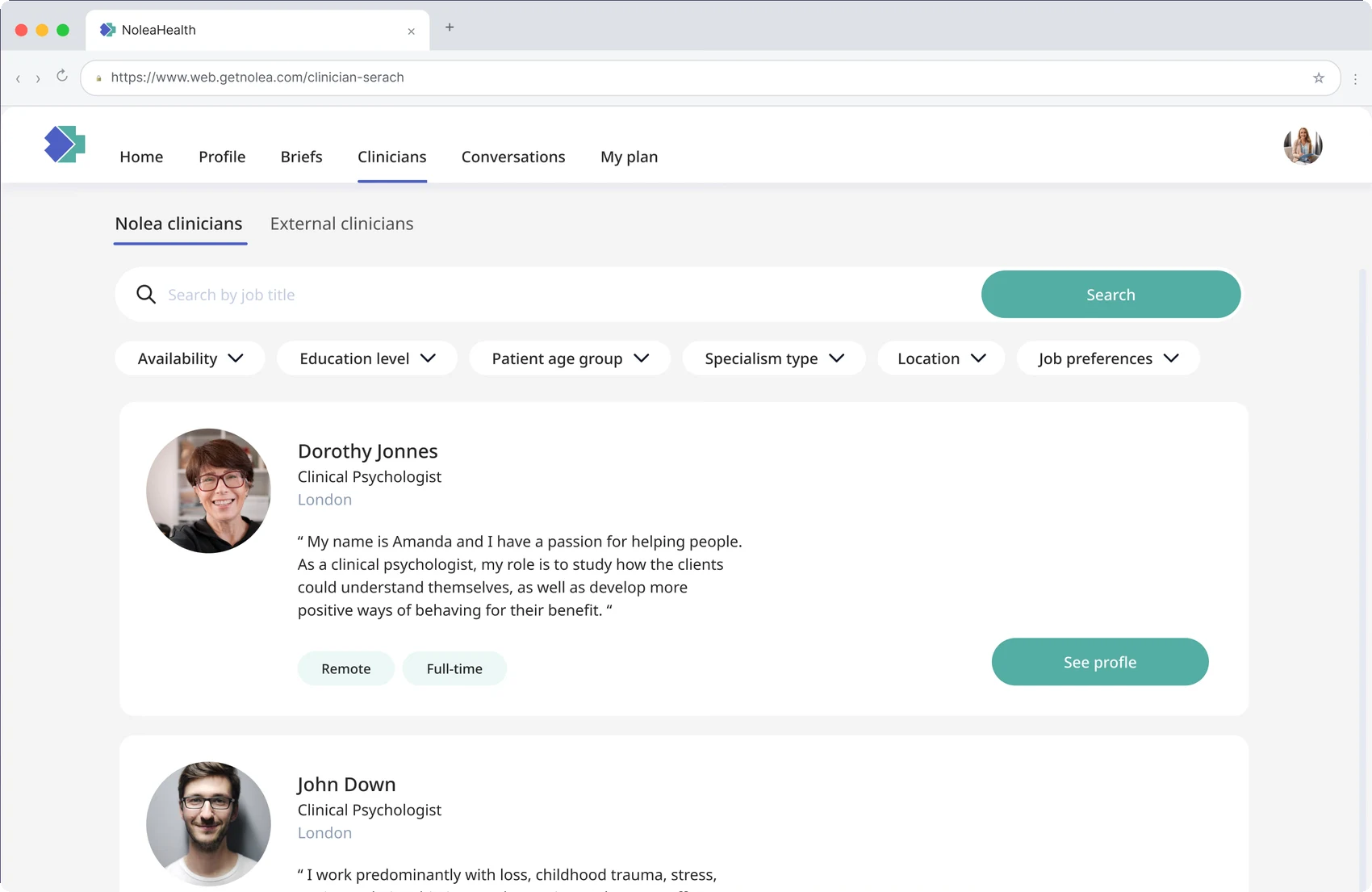
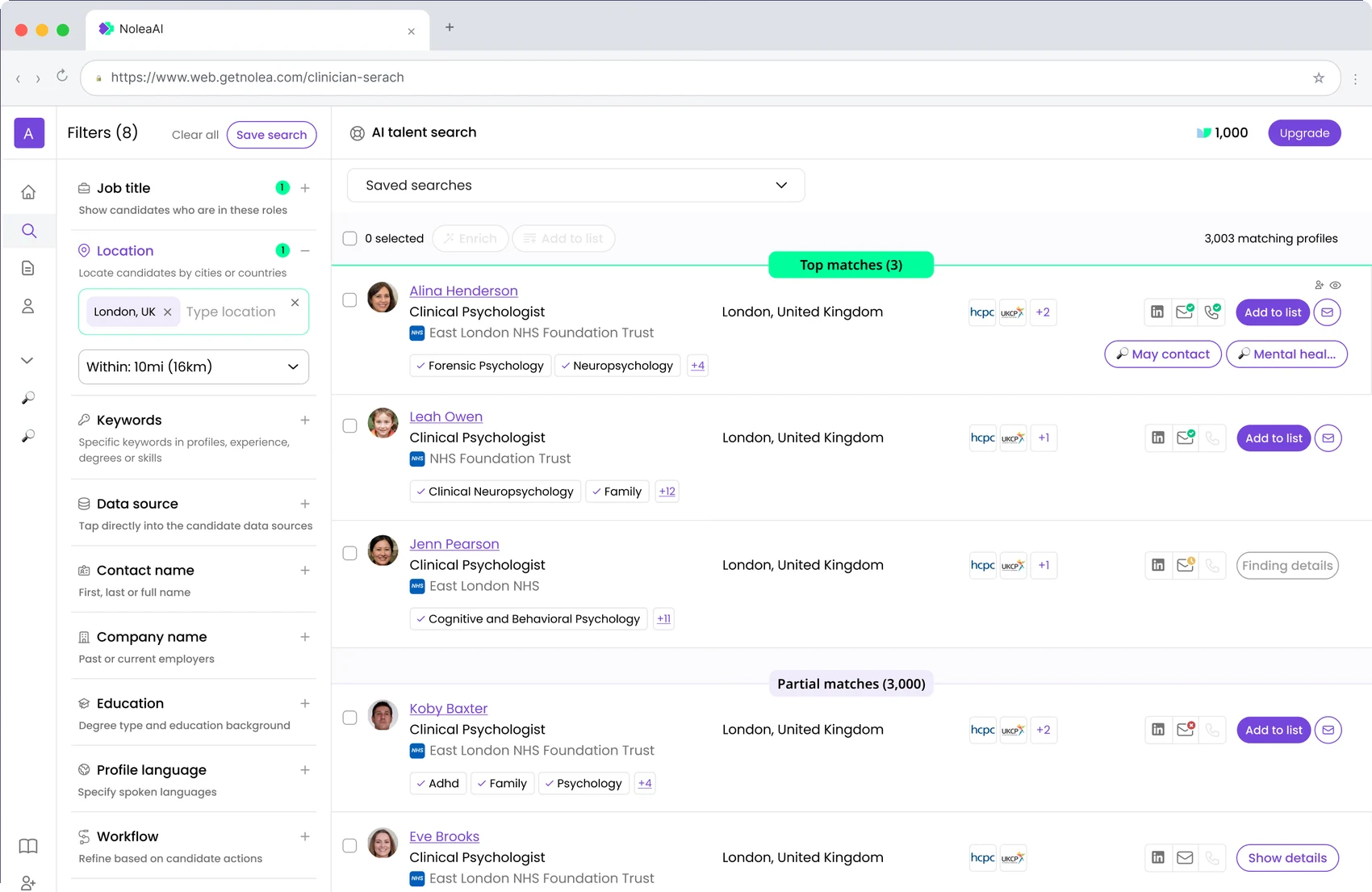
FIND THE UNFINDABLE
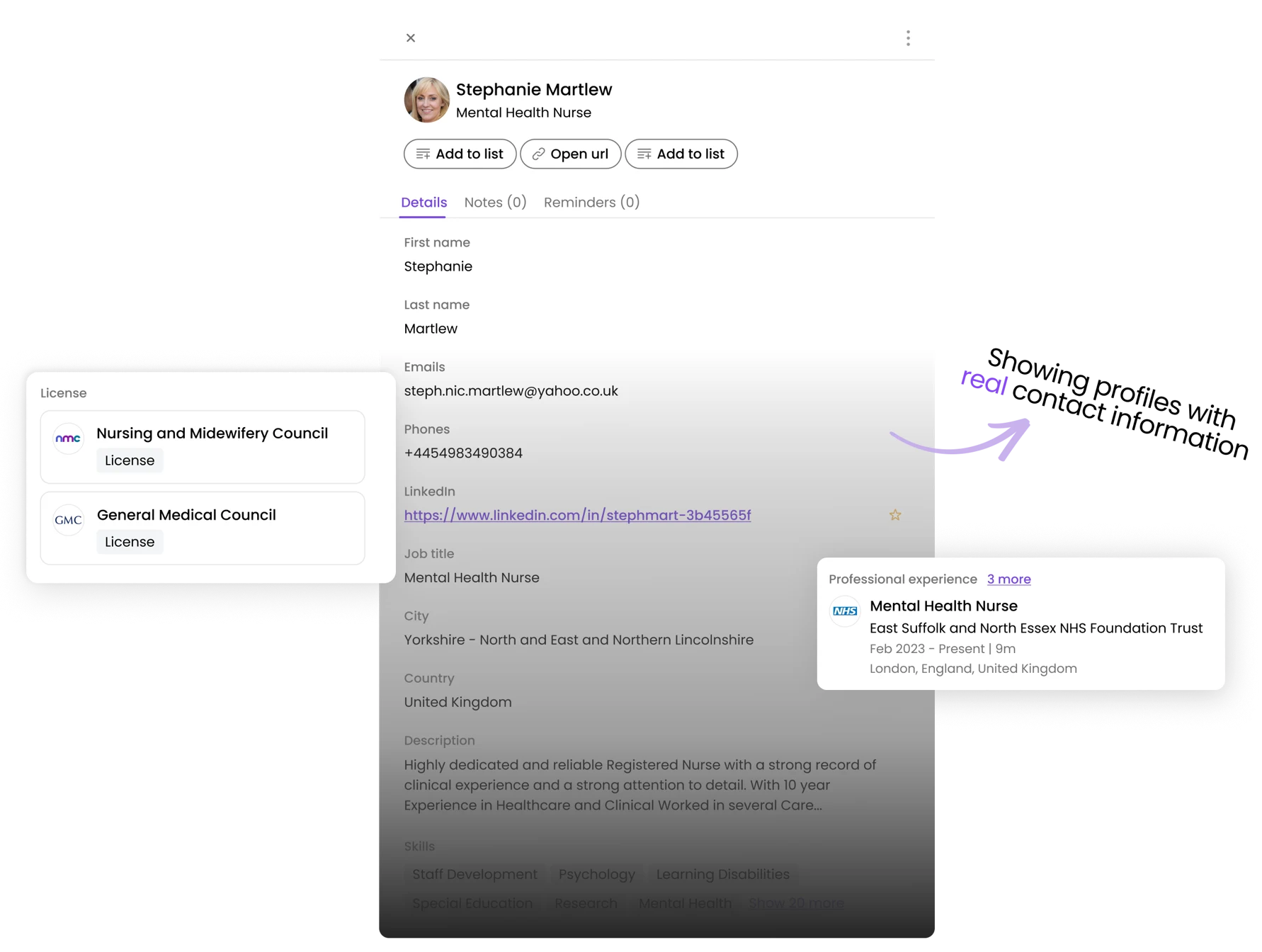
Hiring managers could search across the verified UK clinical workforce and surface real, contactable people behind register records that had never been searchable before. Unlike LinkedIn, which only surfaced clinicians who had chosen to be visible, or specialist job boards, which only showed active job seekers, Nolea reached the passive majority - the experienced, in-demand practitioners who weren't looking but were exactly who companies needed.
Recruiters could search, evaluate, and organise healthcare professionals within one platform.
Each candidate's profile card had one goal: help recruiters make a confident decision without needing to open multiple sources or search elsewhere.
Every element was designed around a key decision question:
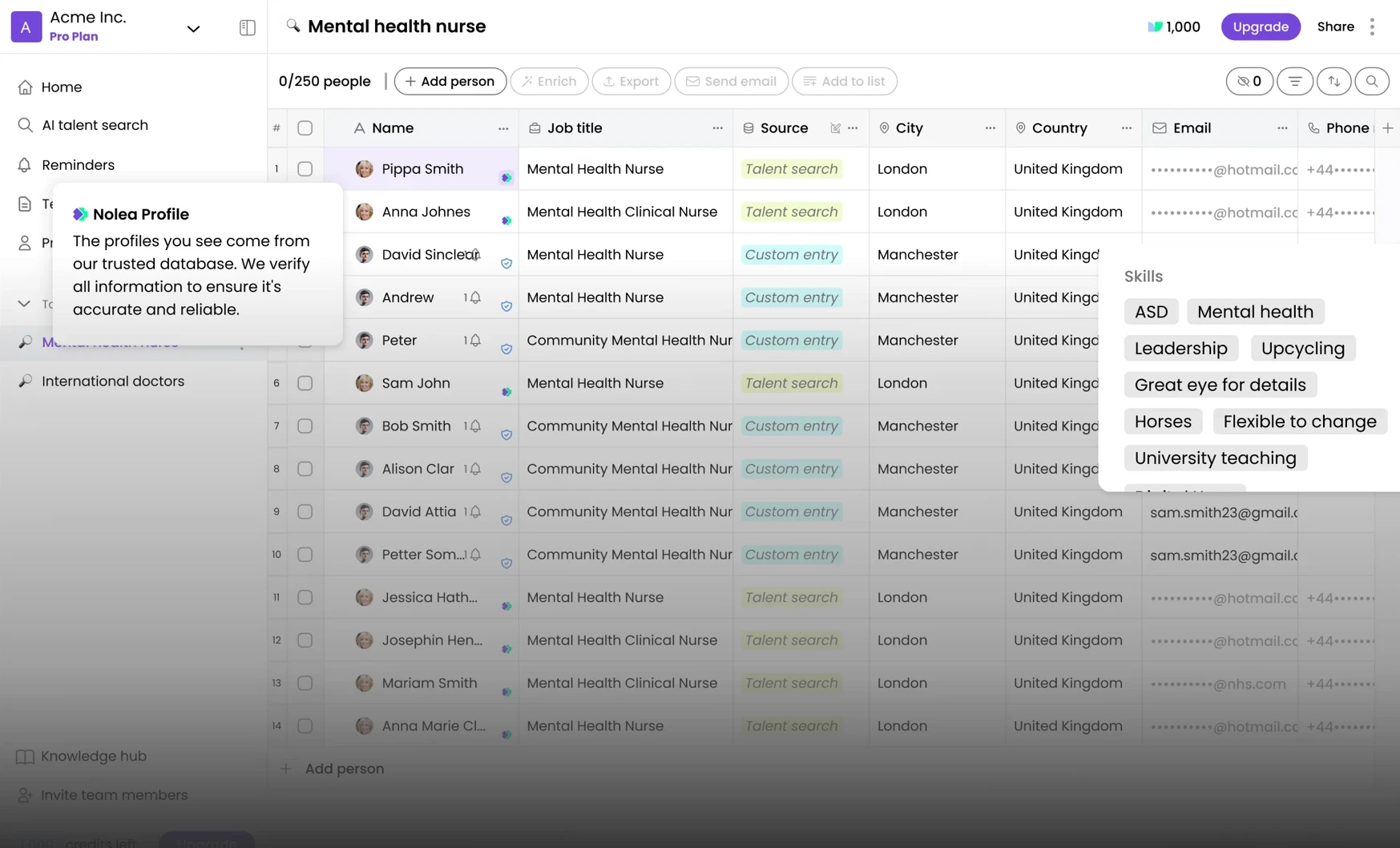
AI talent lists
Recruiters could save candidates into curated talent lists - a direct replacement for the sprawling Excel sheets that hiring teams were maintaining manually to track potential candidates.
Talent Lists transformed candidate sourcing from a manual process into an AI-assisted workflow. The platform automatically identified relevant healthcare professionals and added them to curated talent pools, allowing recruiters to spend less time searching and more time evaluating and engaging with potential candidates.
Validated through weekly customer feedback sessions, talent lists became the most-used feature in the product because it matched how recruiters already worked — building pools of potential candidates before an immediate hiring need existed.
Smart outreach
Finding the right candidates was only the first step. Recruiters still relied on fragmented workflows to contact them — manually writing messages, switching between tools, and tracking conversations across inboxes and spreadsheets.
Smart Outreach brought this process into one workflow, allowing recruiters to send personalised messages to multiple candidates directly from the platform while keeping communication connected to the candidate profile.
Chrome extension
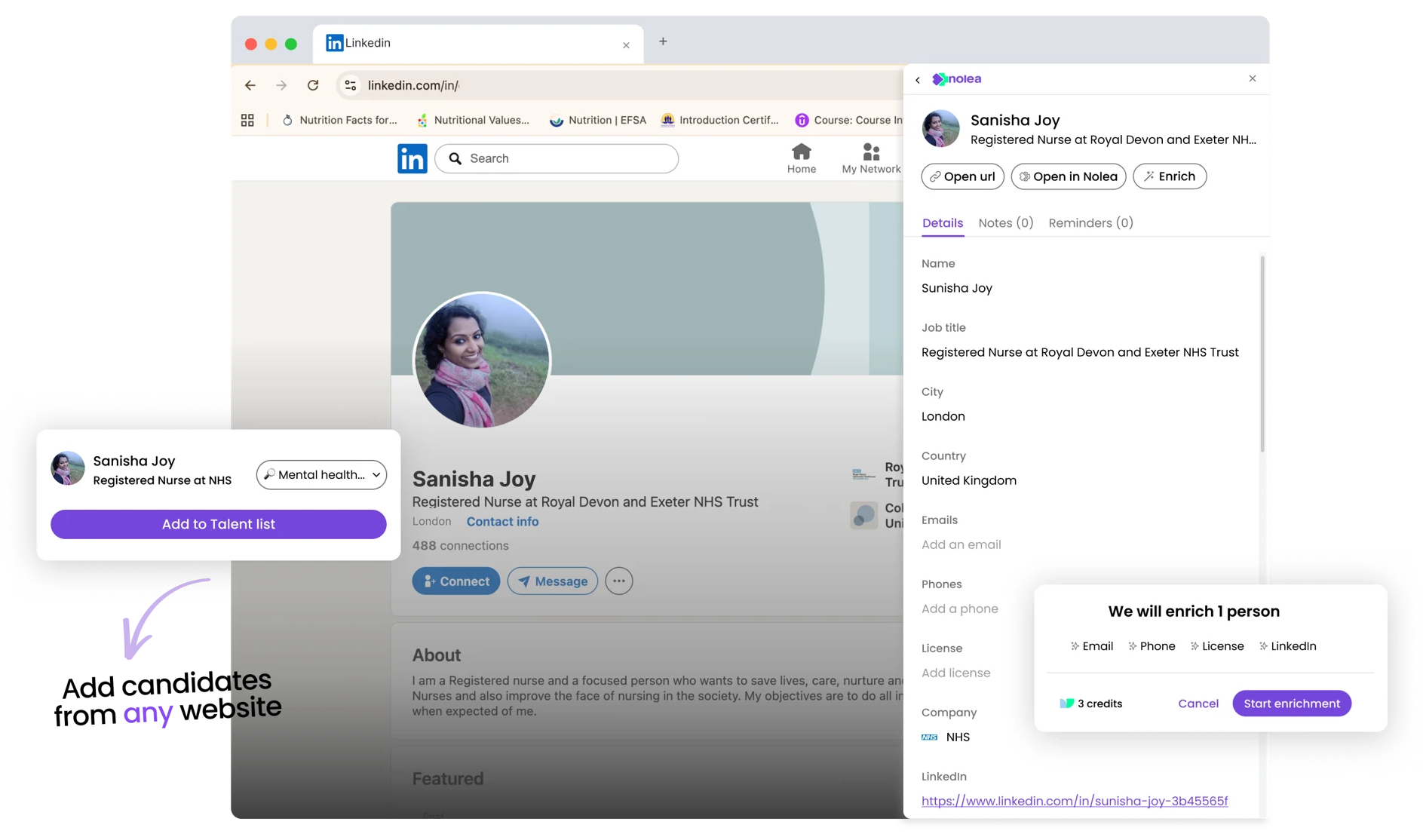
The Chrome extension allowed recruiters to add potential candidates straight to their talent lists directly from external sources such as LinkedIn, professional directories, or their inbox. This turned a fragmented sourcing process into a connected workflow.
Instead of switching between tools, copying information, and losing promising candidates across multiple tabs, recruiters could capture and enrich candidate profiles with a single action.
THE PROCESS
Interviews with hiring managers
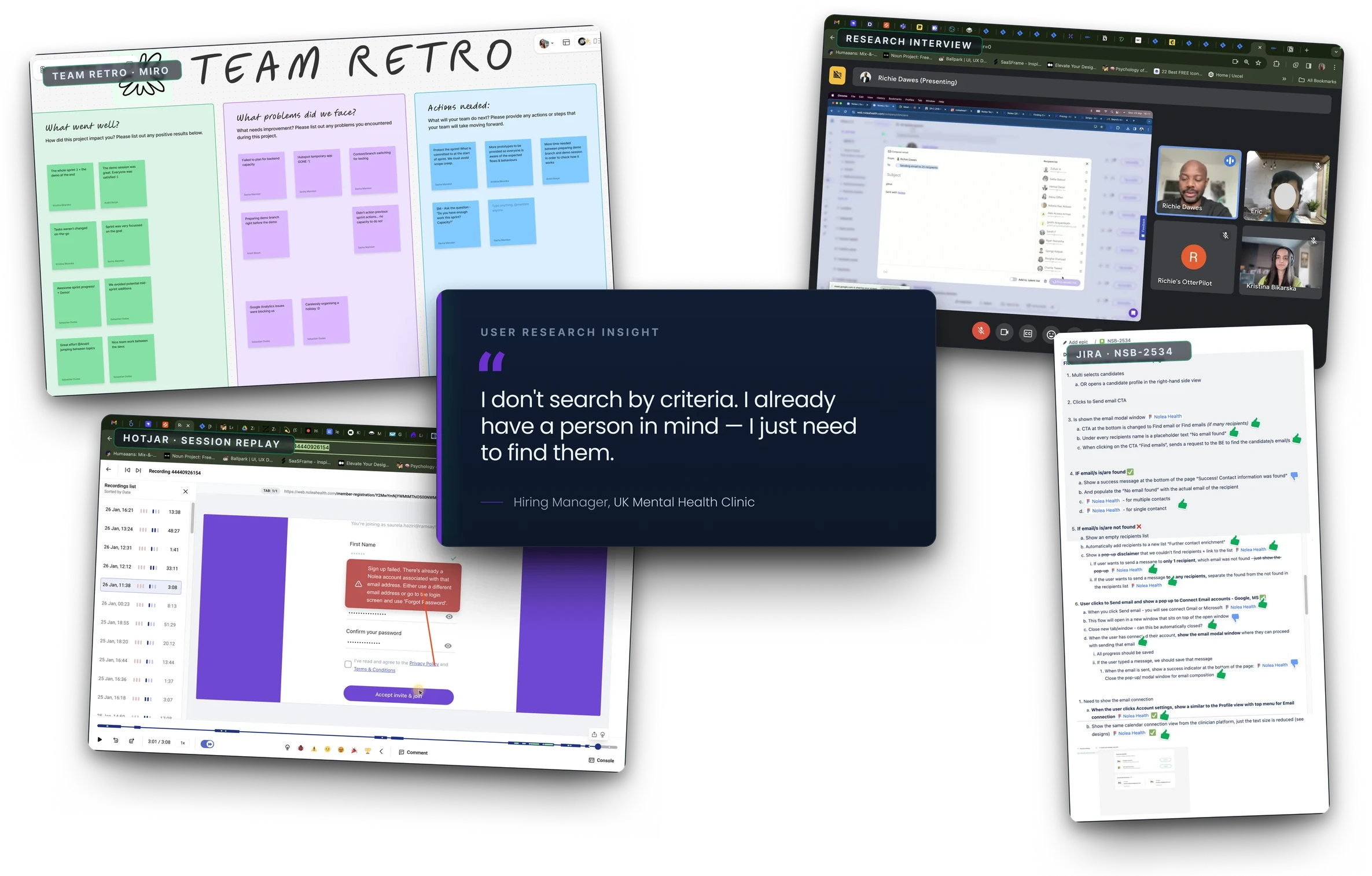
↻ FlipResearch interviews with hiring managers to understand how they currently searched and what frustrated them most.
Usability testing sessions
↻ FlipUsability testing sessions on early designs.
Hotjar behaviour analysis
↻ FlipHotjar behaviour analysis tracking how users moved through the product in the live environment.
Direct customer feedback
↻ FlipDirect feedback from Priory and HelloSelf during active pilots.
Competitor analysis
↻ FlipCompetitor analysis mapping how adjacent tools like HeroHunt.ai approached search UX and where they fell short.
The clearest insight from that research: recruiters weren't thinking in filters. They were thinking about people. They would say things like, "I'm looking for someone similar to..." instead of listing five search criteria. That helped me realize the search experience needed to feel more flexible and less like filling in a form.
Design moved fast and directly into high fidelity - informed enough by research to skip extended wireframing. I worked in rapid prototyping loops with the CEO, pressure-testing design decisions against business logic before they reached the development team. The three surfaces I designed most deeply were the search results and filtering UI, the clinician profile card, and the talent lists - the core daily workflow for any hiring manager using the platform.
Live pilot feedback became the final design layer. Hotjar sessions and live ones with Priory and HelloSelf users revealed friction points that testing hadn't caught - small interaction failures between the production and testing environments, drop-off moments in the talent list flow, and confidence gaps around how incomplete data was being presented.
KEY DECISIONS
Decision 1 - Pivot, pivot, pivot
↻ FlipThe research had been pointing here. We dropped the brief-matching flows, rebuilt search as the core product, and redesigned Nolea's entire external communication to reflect the new direction.
Decision 2 - Focus on improving the candidate search
↻ FlipTwo things made it hard. Profiles were being added and enriched daily, with information scraped from different sources — so the same field could arrive in five different formats and had to read as one consistent thing in the UI. And the ranking itself wasn't always transparent: results came back, but we couldn't always explain why a particular person was at the top. That kept us iterating on the results layer longer than on anything else in the product.
THE PM WORK
Design decisions were only half the job. The other half was deciding what got built at all, and in what order — with a small engineering team, a live pilot running, and a roadmap that had to hold up under commercial pressure.
Owned the roadmap
↻ FlipI kept track of what was coming next and why, and made sure we didn't drift from it week to week. But the plan bent to evidence more than once. We shipped email outreach basic first, with templates planned for later — then customer feedback showed how much time recruiters lost rewriting the same message, so templates moved up.
The harder version of that: for a while we focused heavily on search, because it was the core flow and I wanted it to be the strongest part of the product. Meanwhile recruiters kept asking for more from talent lists and we kept pushing that back. I didn't notice that trade-off as quickly as I should have.
Ran delivery and QA
↻ FlipTwo-week sprints in Jira, scoped against what the team could actually ship. I wrote the user stories, and the acceptance criteria mattered more than the format — what shows when a search returns nothing, what happens when a record is incomplete. Answering those before the sprint started is most of what kept us from redoing work. I also tested features before they shipped; I'd written the criteria, so I was the one checking we'd met them.
Worked with the CEO daily
↻ FlipHe brought commercial urgency — investor expectations, client pressure, what needed to be true for the next pitch or renewal. I brought user and delivery reality — what recruiters actually needed, what the team could realistically ship. Most decisions landed between those two positions.
Kept an eye on the market
↻ FlipOngoing analysis of adjacent tools, including HeroHunt.ai, wasn't about copying features. It was a check that we understood where the market was heading and weren't solving a problem in isolation.
Prioritised ruthlessly for enterprise
↻ FlipWith Priory Group, HelloSelf and Royal Devon NHS Trust in active pilot conversations, every sprint decision carried commercial weight. I prioritised using three inputs simultaneously: MoSCoW framing, customer feedback and CEO alignement.
THE OUTCOMES
Seed A round led by Frontline Ventures with Calm/Storm Ventures.
Priory Group
12-month paid contract
HelloSelf
Enterprise pilot programme
Royal Devon NHS Trust
Live clinical pilot
Black Founder Programme winner
She contributed directly to our investor pitch materials and helped us land and retain our first enterprise clients. The quality and consistency she brought across design, product ownership, and delivery was central to everything we achieved together.
Now that I look at it it's not enough to say a lot. Two years+ at a startup that pivoted within its first six months, secured enterprise clients and raised over a million dollars in funding, a team of 4 that achieved all of this, led by their ambitious CEO… in retrospect sounds like a clear trajectory. It rarely felt that way from the inside…
The most significant professional development I experienced at Nolea wasn't technical - it was positional. Learning to operate at the intersection of design and product ownership meant holding two different modes of thinking simultaneously: the user-grounded, detail-oriented mindset of a designer, and the outcome-oriented, prioritisation-driven mindset of a product owner. Sometimes I felt the two sides in my personality fighting with each other.
A designer's instinct is to solve the problem completely. A product owner's instinct is to solve enough of it to deliver value now and build on it later. Finding the right balance between those two impulses is something I navigated daily at Nolea and carry with me as a core working principle.
Thanks for reading :)
↺ Turn backThe most significant professional development I experienced at Nolea wasn't technical - it was positional. Learning to operate at the intersection of design and product ownership meant holding two different modes of thinking simultaneously: the user-grounded, detail-oriented mindset of a designer, and the outcome-oriented, prioritisation-driven mindset of a product owner. Sometimes I felt the two sides in my personality fighting with each other.
A designer's instinct is to solve the problem completely. A product owner's instinct is to solve enough of it to deliver value now and build on it later. Finding the right balance between those two impulses is something I navigated daily at Nolea and carry with me as a core working principle.
WHAT I LEARNED
↻ OpenNow that I look at it it's not enough to say a lot. Two years+ at a startup that pivoted within its first six months, secured enterprise clients and raised over a million dollars in funding, a team of 4 that achieved all of this, led by their ambitious CEO… in retrospect sounds like a clear trajectory. It rarely felt that way from the inside…