A mismatch is a comment
On a pull request it is cheap to raise, cheap to fix and nobody has to re-test.
Every sprint, the same rework problem. I reframed it as a scoped product concept.
Work kept drifting from the design and the specs, and nobody noticed until testing. A table shipped without the sorting and filtering a customer had asked for. Colours and icons appeared that weren't in the design system.
tickets came back every sprint
lost per sprint to catching, explaining, redoing and re-testing
of watching the same problem repeat
to scope the concept that could fix it
I was the designer, but I also filled the product manager gap: writing user stories, holding customer requests and shaping the build. I often tested key flows myself because I had the full context. That double role made the gap impossible to ignore.
Pretty much every sprint, a few tickets came back because what got built didn't match what was specced - and it usually surfaced in testing, after the work was already 'done'.
Better handoff docs, more QA and extra sync meetings were all tried. None of them stuck, because they asked people to be more careful, while the mismatches came from deadline pressure.
On a pull request it is cheap to raise, cheap to fix and nobody has to re-test.
It costs a loop of reporting, explaining, redoing and re-testing, every single sprint.
The shift: stop trying to make people more careful and change when mismatches get caught. One automatic check right before merge compares what was built against what was intended.
The goal was to test whether a merge-time check changes how the team works. When a pull request opens, it is linked to its Jira ticket and checked for three things.
Is a required UI element present or missing?
Is each step of the flow there?
Does the layout roughly match the design?
Left out on purpose: AI judgement of code against design, and pixel-perfect comparison. I wanted to learn first whether a simple gate changes behaviour at all.
A check only helps if people trust it and act on it. The report lives on the pull request and reads in seconds, with a compact status in the merge box and a detailed comment with the findings.
Status first, then the most severe finding, then the next action.
Findings are specific and tied to the user story, so engineers act on them instead of dismissing them.
The next step is clear in every state.
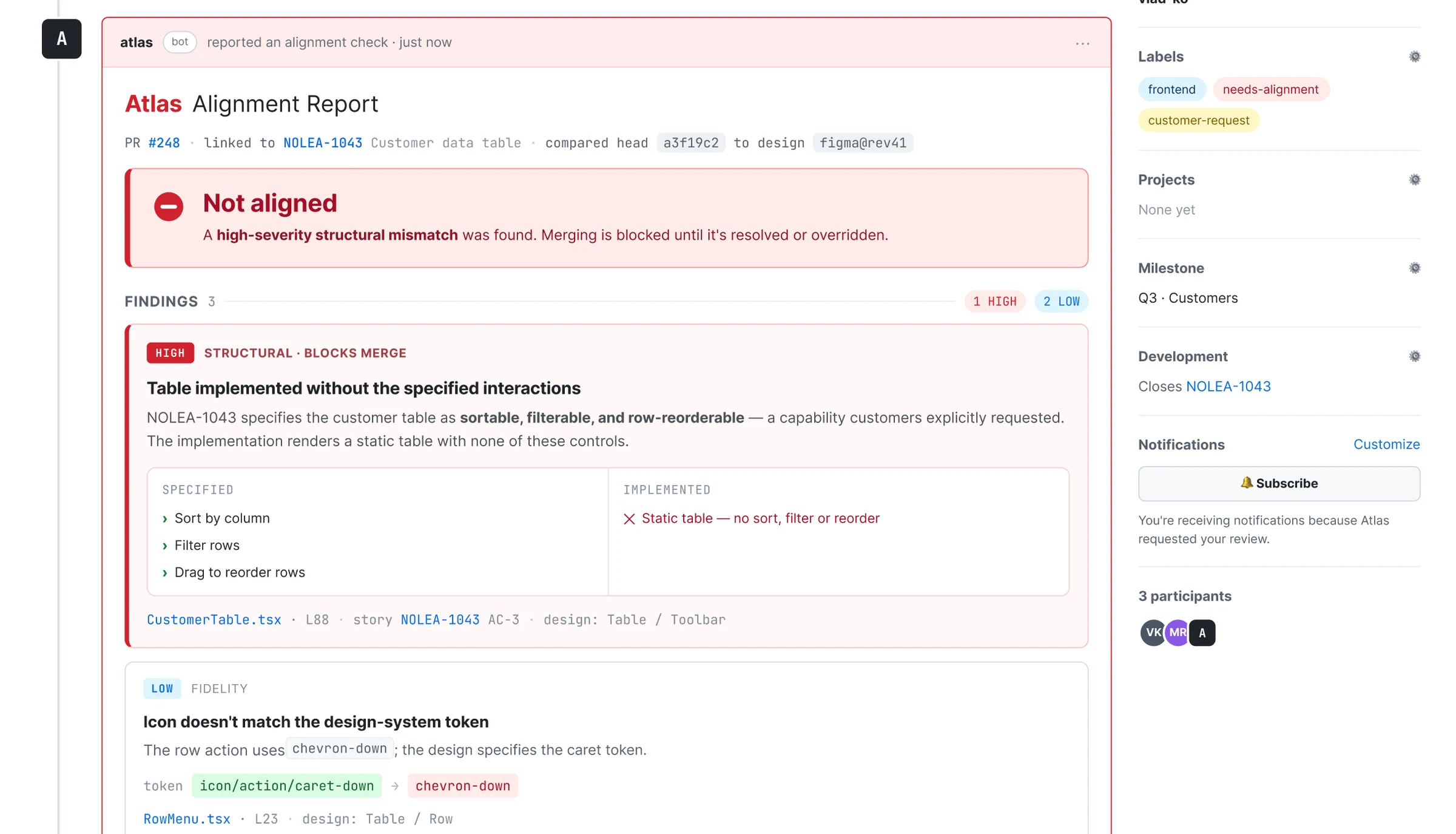
Overrides: a blocked merge can be overridden with a short reason. That avoids resentment and workarounds, and the logged reasons show where the rules are too strict or missing context. It is how the system would learn.
Atlas was never built. It came from a problem the team lived with for months and was scoped into a product plan. The core bet: catching a mismatch before merge is cheaper than after.
That last signal would mean the rules are wrong, so it counts as a metric too.
A missing element or a missing step in the flow.
A table can contain every required feature and still be built wrong. I accepted that, to test the gate before investing in something smarter.